
EPISODE 13 – TWO DAWNS FROM NOW

SONG
LYRICS - TWO DAWNS FROM NOW - Alpha Feet Mafia
A gray Fiat shone beneath the waking light
The kind that doesn't come here overnight
They called his name, "Georgio, my good friend"
But every word was business to its end
He walked out barefoot, calm as any lord
A man who knew the weight behind each word
He met the dark man on the open way
And silence told what none would dare to say
Two dawns from now
Two dawns from now
Two dawns from now
It's the only thing I could hear
What could it mean? What could it be?
Two days from now, two days from now
What will it bring? What waits for me?
One checked his watch, the other lit a smoke
The silence thicker than the dust they woke
"Day after tomorrow," softly said
A promise that could buy the living or the dead
He glanced my way, no tremor in his face
No mercy there, no memory, no grace
A nod as cold as marble set to stay
And something holy bled to gray
Two dawns from now
Two dawns from now
Two dawns from now
It's the only thing I could hear
What could it mean? What could it be?
Two days from now, two days from now
What will it bring? What waits for me?
He watched the car until it left the bend
Then looked at me, a nod, a quiet end
He turned inside, the door closed soft and slow
And I stayed there, not knowing what to know
STORY
And then I heard it again. That engine sound. No longer in a dream. From outside. Deep. Heavy. Slow.

A sound that does not simply appear in a village like ours. No one passed “by chance” with a car. Only a few could afford one—aristocrats, officials… and those whose names are not spoken.
I stood up.
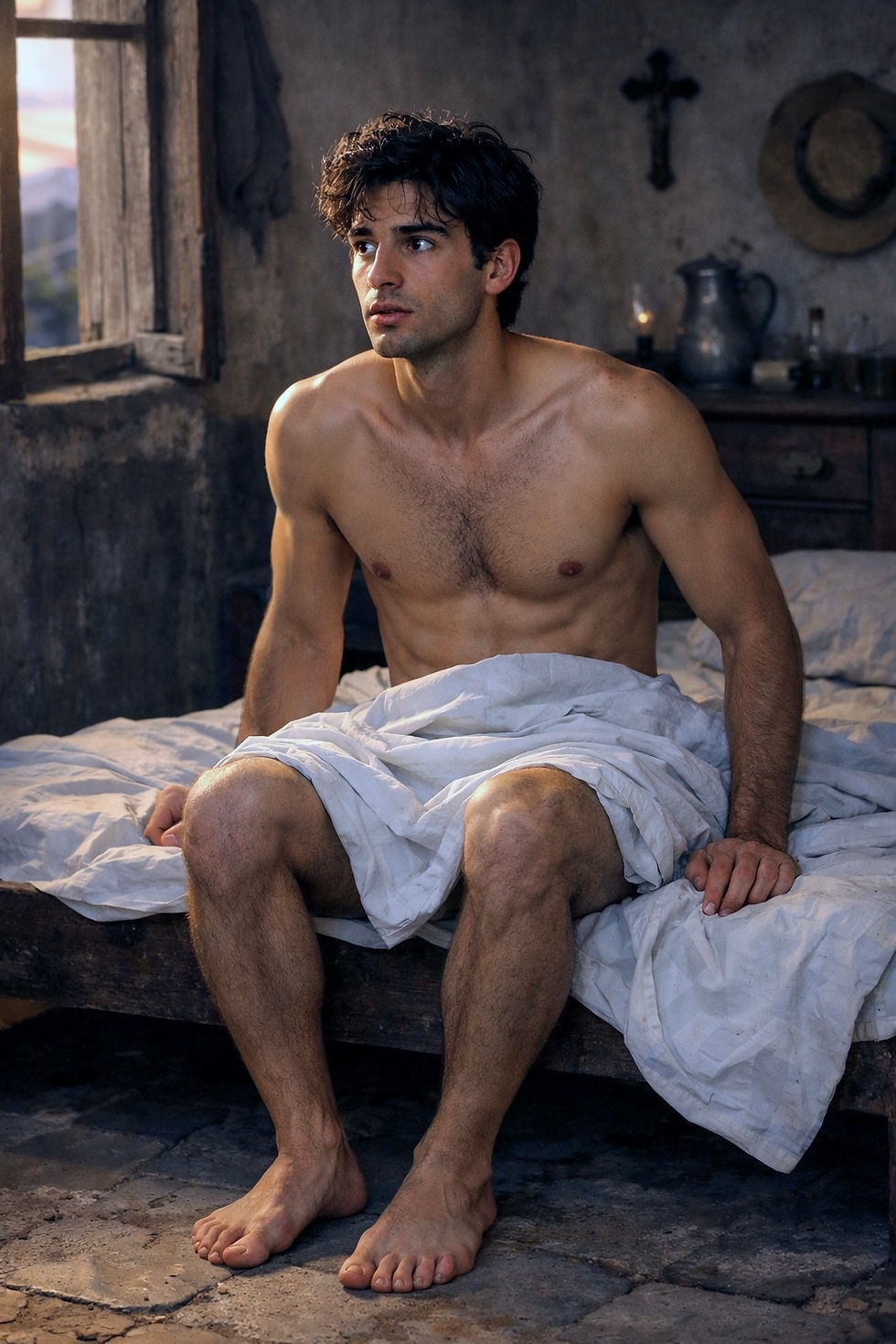
Barefoot, I set my feet on the wooden floor.

I moved to the window and pressed the curtains slightly aside. Just a slit, wide enough to look out, narrow enough to remain unseen.
And there stood a dark gray Fiat. The driver cut the engine, and two men stepped out.
Not the kind of men one usually sees in our village.
The first was slim, almost elegant in his thinness. Polished. Olive-pale skin, a long face, and above his right eyebrow a fine scar, so precise it looked like a deliberate mark. His mouth was clean-shaven, only the faintest shadow of a mustache, so thin it seemed like a thought one might wipe away. On his head he wore a black felt fedora with a center crease and side dents, as if it were not a hat but a sign.
His suit was double-breasted, anthracite wool, with a waistcoat. A white shirt with a stiff collar. A dark, narrow tie fixed with a small pin. Black Oxford shoes, cleaner than any kitchen in the village. A signet ring on his hand. A wristwatch at his cuff.
And that look.
Controlled. Assessing. As if he did not see people, but possibilities.

The second man was the opposite—broad, heavy-set, with darker, sun-weathered skin. A square face. A crooked nose that must once have been broken. A notch in his left earlobe, as though someone had taken a piece out of it. At the left corner of his mouth a small scar, like a cut that never fully healed. He wore a dark gray tweed flat cap with a herringbone pattern, a dark tweed jacket, a dark waistcoat, a cream-colored shirt open at the collar, and a dark neckerchief. His trousers were wide and dark gray, his ankle boots dark brown.
In his right hand he held a cigarette.
His gaze was restless, scanning. Not fearful. More like someone constantly feeling for where the next mistake might occur.

I did not need long to understand what kind of men they were.
Here, one did not call them “businessmen.” One said nothing at all. One lowered one’s voice, closed the shutters, and pretended not to see.

Then I heard the slim man’s voice—too bright for what he was, too friendly for what lived inside him.
“Giorgio, my good friend! Come, let us kiss each other’s hands,” he said. And yet it did not sound like friendship.

It sounded like business. Like something unfolding, much like the nightmare I had just dreamed, no matter how kindly it was wrapped.
The door opposite opened.

Giorgio stepped out. Barefoot. He wore those loose beige trousers I had come to know, his upper body bare. The early light lay across his skin, tracing soft lines over muscles and veins that were not made for beauty, but for work.

He did not walk hastily.
He did not walk cautiously.
He walked calmly, as if he were master of the moment, even if he had not summoned it. As if he already knew every word before it was spoken.
He did not remain directly before his door. He stepped out onto the open path, a few paces away from the walls, as though he did not want the stones to listen.

They spoke quietly. Deliberately. I could hear nothing. Only from their faces could I tell it was about something serious. Something dangerous. Something forbidden.
The smoker lit a cigarette and drew deeply, slowly. The smoke curled into the morning air, and with it rose the dust the Fiat had brought. It was as though the air itself grew heavier.

The elegant man lifted his arm, turned his wrist, checked his watch and pointed to it—a gesture almost casual and yet unmistakable. This was about time. About deadlines. About something that could not be negotiated.

The silence between them was not empty. It was thick. Thicker than the dust they had stirred.
Then I heard it.
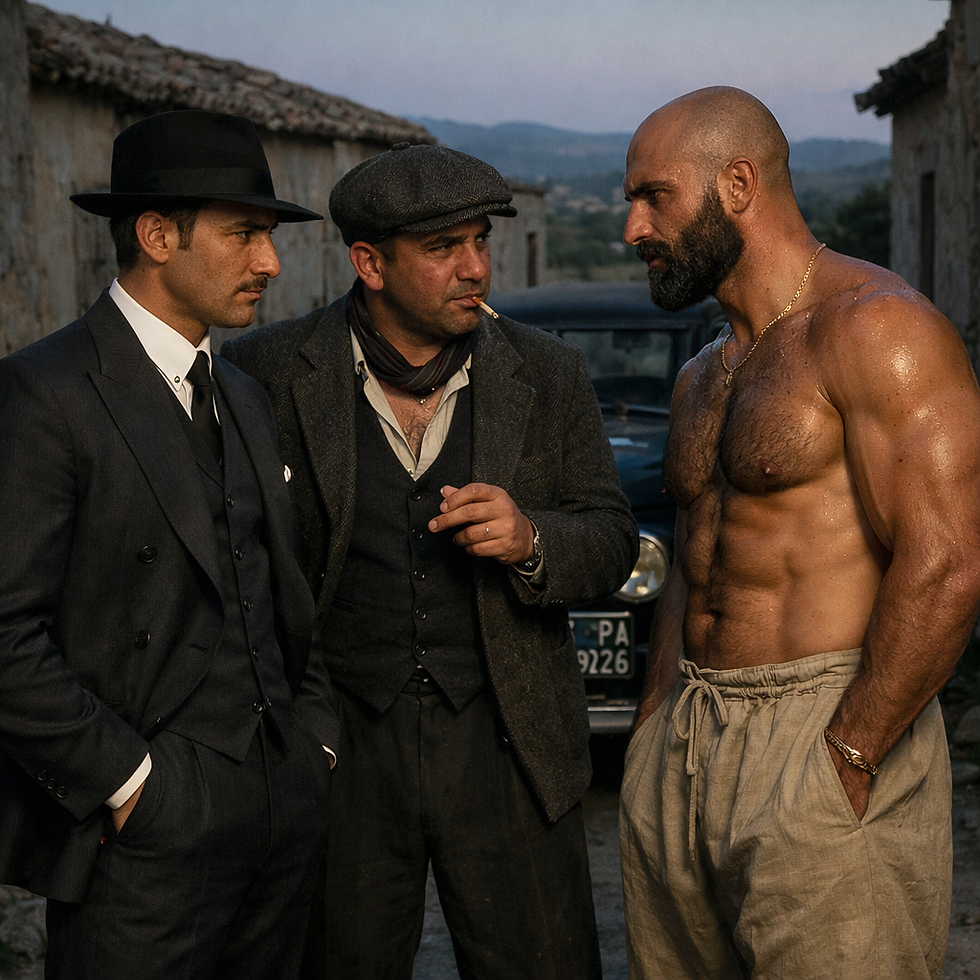
Not everything. Only one fragment, as if the world chose to grant me exactly what it wished, and no more.
Giorgio’s voice—deeper than usual, not warm, not tender, more like stone.
“The day after tomorrow,” he said. Short. Final.

That was all I heard.
Everything else remained in the haze: low voices, the rustle of cloth, the brief pull at a cigarette. Only that word rang in my head like a bell.
What could it mean? What was to happen the day after tomorrow?
In two dawns. Two days from now.
And as if he had heard the question in my mind, he looked in my direction.

Perhaps it was foolishness. Perhaps hope. Perhaps that childish longing in me that still believed a single glance could save everything. I opened the curtain a little more.
I raised my hand. Very slightly. A wave, not a call—only a silent: I am here. I see you. You are not alone.

And his gaze… remained smooth. No flicker. No warmth. No “boy.” No smile to catch me. As if there were nothing between us—no blanket in the olive grove, no dream, no hand on my leg, no “good” at the end of the day.
No recognition. No mercy. No memory.

I lowered my hand as if I had burned it.
And inside me, something turned gray.
The man with the cigarette said, almost as confirmation, almost as a translation for something that must not be misunderstood:
“The day after tomorrow. In two dawns.”

He said it softly, yet there was something merciless in the softness. A date that could not be bargained with.
The smoker stepped closer to Giorgio and almost whispered something into his ear. His expression could have cut stone.

I saw only that Giorgio’s face shifted slightly. A trace of concern. As though he had heard something more dangerous than what the two already carried. As though the smoker had driven a nail into his flesh without drawing blood.
Giorgio said nothing. He only nodded.
Then the smoker extended his hand.
Giorgio took it. Not a friendly shake. More an exchange: You know. I know. We do not forget.

The smoker turned his head briefly. I instinctively pulled mine back, hoping the curtain would make me invisible. My breath caught as his gaze slid over the windows—over mine as well. Not long. But long enough to make me cold.
He did not look curious. He looked measuring. As if noting where eyes were.
I saw him take the last drag as they walked to the car. He held the cigarette briefly between two fingers, as if it were nothing more than a remainder to be discarded. Then he flicked it away—toward Giorgio. Not by accident. Deliberately.

It flew in a flat arc and landed at Giorgio’s bare feet.
A tiny, glowing point.
The tip flared bright, a small red eye unashamed to be seen. Smoke curled upward as if it still wished to speak.
Giorgio looked down at it.

Only for a moment. But that moment was heavy.
I watched him so closely I felt I could see something shift in his face—not fear. Not panic. Rather that brief, silent calculation of a man who has learned that small things are often the real messages.
His gaze lingered on the cigarette, and suddenly I thought: This is not trash. It is a sign.

Like a stamp.
Like tossing something before an animal to see if it flinches.
Giorgio did not step back. He did not jerk his foot away. He did nothing hurried. He simply stood there, as though he had forgotten he was barefoot.
But I saw his toes tense, just slightly.

The elegant man was already half inside the car. The smoker turned once more, slowly, as if to check whether Giorgio truly remained calm. His eyes traveled over Giorgio’s chest, the broad shoulders, the beard, the shaved head—and then, for a brief instant, rested on Giorgio’s feet.
On the cigarette.
Then, as though the verdict had been reached, he pulled the door shut.
The click cut through the air.
The engine started.
Deep. Heavy. Slow.
The gray Fiat moved off, rolling down the road as though it had all the time in the world and yet a fixed appointment. Dust rose again.
Giorgio remained standing.

I watched him follow the Fiat with his eyes until it took the bend at the end of the road—that curve beyond which one can no longer see who comes or goes—and only when the car disappeared did he move.
He bent down, picked up the burning stub between two fingers and pressed it out in the dust. He did not leave it there. He kept it in his closed hand, as if he had to remove the dirt the two had left behind—the proof of a visit unwelcome in the village and not to be connected with him.
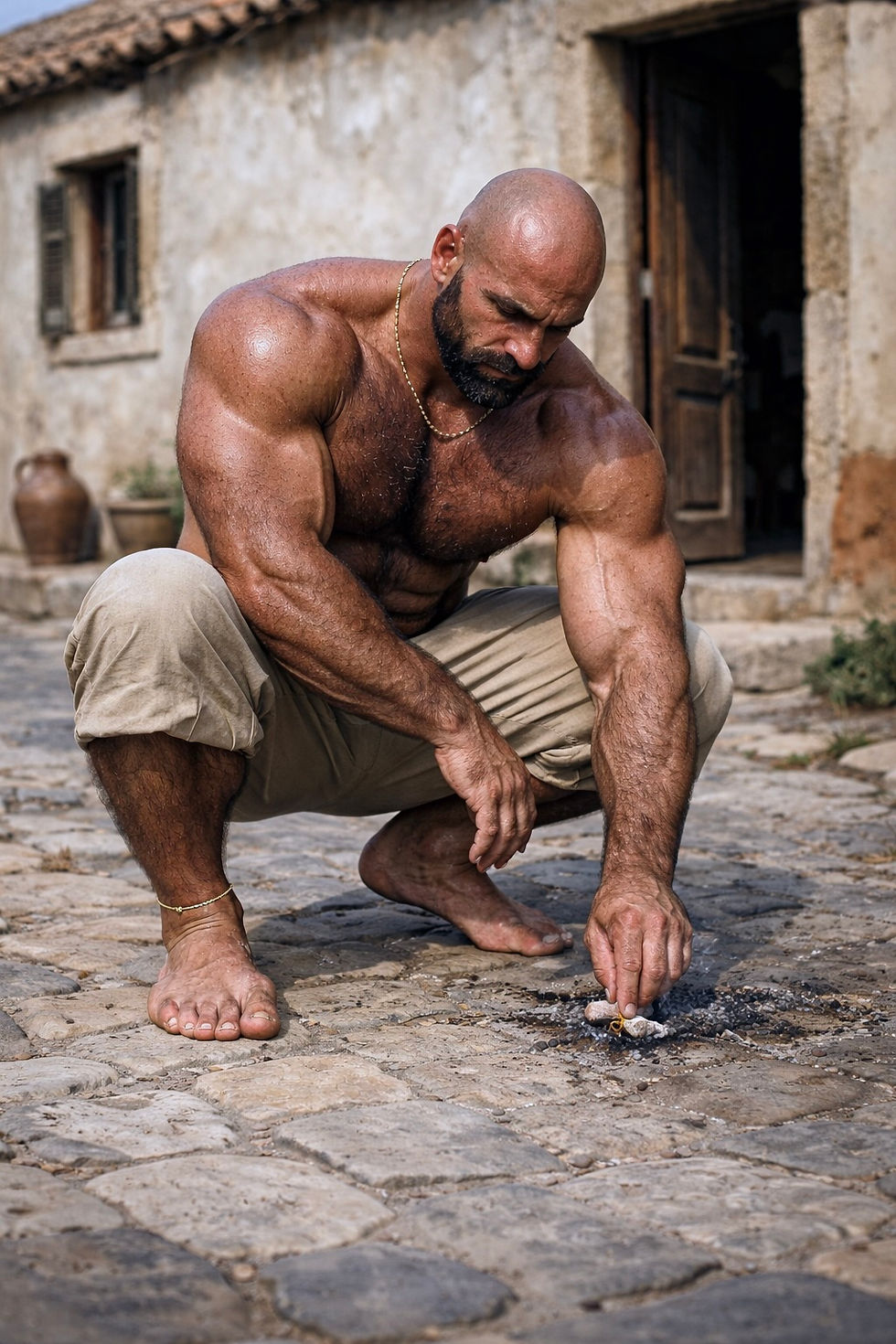
He lifted his head—and looked at my window.
I pushed the curtain fully aside. I did not dare wave or smile. I only looked at him.
He said nothing. He gave me a nod. Small. Calm. Barely there.

Then he turned, went back into his house, and the door closed softly, almost gently—as if it were preserving something, not shutting something out.

And I remained standing.
With my fingers on the curtain, not knowing what I needed to know. Only that something had shifted beyond my grasp—and that Giorgio was entangled in things I did not understand.

Something that would happen the day after tomorrow.
And the day after tomorrow was not far.
Only two nights.
