
EPISODE 14 – LIKE A GOD

SONG
LYRICS: LIKE A GOD - Alpha Feet Mafia
Two men, a car, their echoes fade away,
Their words still circle in the heat of day.
I drink the water, warm and rough with clay,
And see him standing as a warm summer rain.
The suits were clear - I knew what kind of men,
I told myself, I can’t be one of them.
I crossed the room, the window drew my breath,
He sat outside - creation’s soul made flesh.
Whatever waits, whatever may befall,
I’d kneel before him; I would risk it all.
He moves, and even shadows seem to nod.
He is, he must be, something like a God.
like a god, like a god, a god, a god ...
I couldn’t help it - I must write to him,
I found a sheet, a pencil worn and thin.
I took my seat and faced the morning star,
He was so fair - my heart became the dawn.
How do you write to something more than man?
My hands forgot the letters they began.
He sat outside - the sunlight made him whole,
And every word was kneeling in my soul.
Whatever waits, whatever may befall,
I’d kneel before him; I would risk it all.
He moves, and even shadows seem to nod
He is, he must be, something like a God.
like a god, like a god, a god, a god ...
My hand is weak, the pencil starts to sway,
The window glows, the dizziness drifts away.
I close my eyes - the words begin to stir,
And pour my heart on paper, all for him.
STORY
Two conspicuous men. Their voices were gone. Their gray Fiat was gone. But their words remained.
“Day after tomorrow.”
Not even a full sentence, and yet it turned inside my head like a wheel that cannot be stopped. Day after tomorrow. In two dawns. Two sunrises, two nights, sleep twice, wake twice — and then something would happen, something Giorgio had said — and that the man with the cigarette had pressed once more into my ear, like a stamp. Something the two men in suits demanded of him without naming it aloud.
I looked at the door across the street. It was closed.
Closed as if it had shut me out. Not in haste, not in flight — rather with that calm that feels like a lid. As if he had ended the scene like a book one must not leave open, because someone might read along.

Just before that, only that nod — that was all. A small, quiet sign: I have seen you. Or perhaps only: Look away.
And I… I had seen.
Too much.
Or too little.
Outside, the air was already warm again, though it was still morning. Sicily was not patient. It grew hot quickly, bright quickly, everything too quickly unmistakable.

I pulled myself away from the window, dressed, and went into the kitchen as if walking were something that could help. As if movement could put thoughts in order. The stone floor beneath my feet was pleasantly cool. My grandparents’ house breathed in its own rhythm, creaked softly, as if to remind me. You are alone, boy. Be careful.
On the table stood the clay jug I had filled the night before. I poured myself a glass and drank. The water was no longer cool. It was lukewarm, almost warm, and it tasted of clay, of earth, of the vessel that held it.
I kept drinking, as if I could wash the pressure out of my chest.

But instead of calm, he returned.
Giorgio.
Not as a thought politely knocking, but as an image already there. Large. Heavy. Unmovable. I saw him again kneeling at the spring, scooping water with his hands and drinking as if thirst were not something to negotiate. I saw his chest glistening in the light. I saw him letting the water run over his neck and shoulders, as if he wanted to wash the heat out of himself.

And then — worse, much worse — I saw him by the tree — standing broad-legged, naturally, as if his body were part of a cycle one does not speak about and that still governs everything. And my head did what it always does when it has no chance in such moments: it turned it into something forbidden. Something dirty. Something that does not belong in words.
I felt heat inside me that had nothing to do with the sun. It was unavoidable.
He was like a warm summer rain: nothing one can hold — and yet he makes everything in me damp, soft, receptive. He simply falls, and I cannot stop him — and afterward I am different.
I set the glass down.
I thought again of the men. I could still see them as if they were standing here in the kitchen.
Of course I knew what kind of men they were. Not “businessmen.” Not “visitors.” Not merely strangers. One did not have to grow up in Sicily to understand.
The suits were unmistakable. Not because fabric itself is dangerous — but because there is a kind of elegance that does not want to be beautiful, but superior. That does not ask, but decides. And the slender one had worn that kind as if it were part of his skin.

And the other — the broad one with the cigarette — was the opposite: not smooth, not refined, and precisely for that reason more threatening. A body that does not need to explain itself, because if necessary it explains what pain feels like.
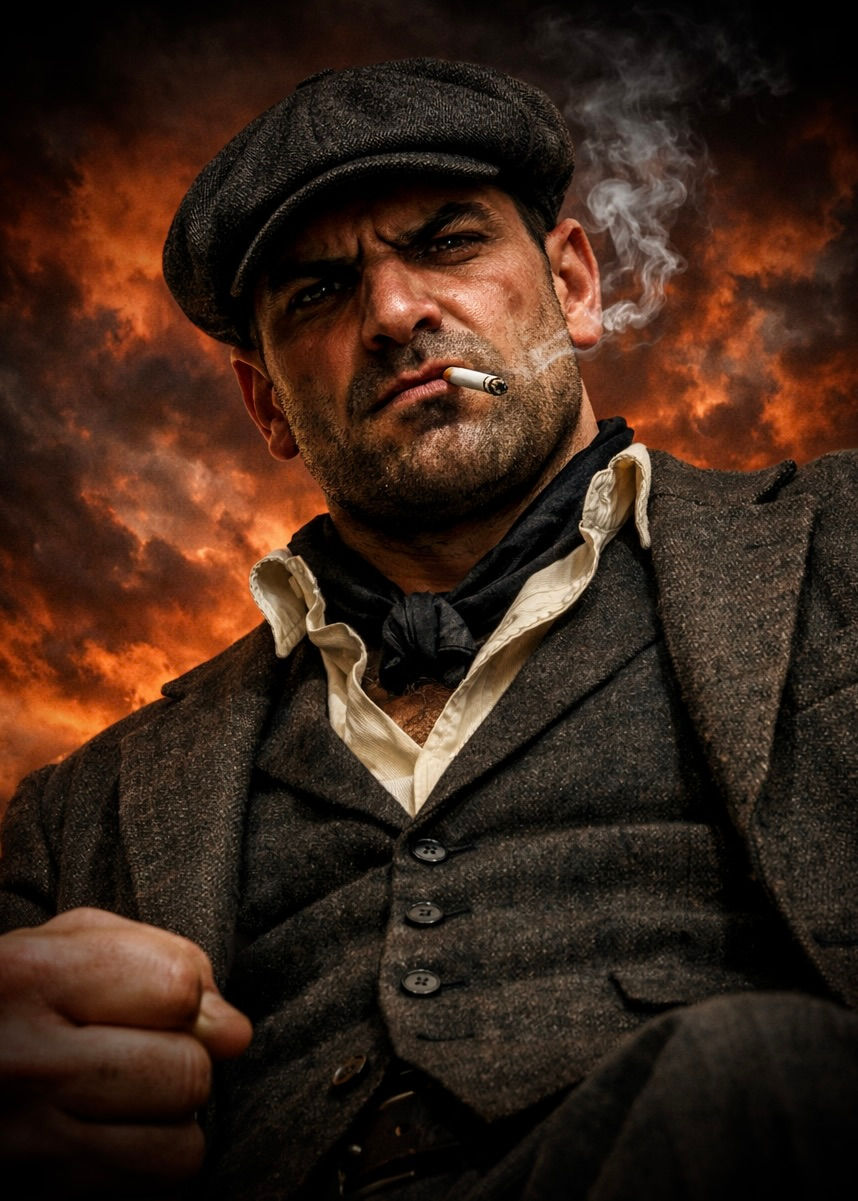
And a Fiat that suddenly appears in a village like ours is not simply a car. It is an announcement.
I told myself: You cannot be one of them.
I said it strictly, like a prayer.
I am not like that. I do not want to be like that.

But in Sicily one could perhaps become “one of them” faster than one could blink. One did not have to belong. It was enough to stand in the way. Or to possess something one of them wanted. Or to be at the wrong window at the wrong time.
I had come back to harvest olives, to save fields, to air out and clear a house that smelled of Nonna Angela, not to be drawn into things that take place in the dark. I was nineteen. I was tired of loud New York, from which I had fled as soon as I had the chance. I wanted only peace.

And yet… had Giorgio not used that very word?
Peace.
“Up here you never sell only fruit,” he had said. “You sell a little… peace as well.”
I had not understood what he meant. I had nodded because I did not want to interrupt him, because his hand on my thigh had made everything in me louder than the sense of his words.

And now, in the light of this morning, I understood too well.
Perhaps that was it.
Perhaps those men were the ones who sold “peace.”
And perhaps Giorgio… was one of them. Or at least stood so close to them that he knew exactly what would happen when one did not have peace.

I pressed my fingers against the edge of the table as if I needed to hold on.
If he really… if he really was something like that — what was I to him?
A boy he had called “boy” yesterday. Whom he had taken into the fields. To whom he had given apples. Whom he had seen on his knees in his dream. Not the way I wanted to understand it.
I saw again his face when he had looked in my direction as I waved from the window.
Smooth.
No smile.
No “Enzo.”
Only stone.

As if he had erased me from his life for a second to protect something larger — himself, the men, the truth, a plan, or all of it together. Or as if he had silently ordered me: See nothing. Know nothing.
What will happen in two days?
And immediately another part of me answered, dark and pictorial: Perhaps he has something to take care of.
Not “an appointment.” Not “an arrangement.” But something one does not pronounce aloud.
I thought of the sentence on the branch: “If you don’t sell, you pay anyway. Just differently.”

Suddenly it was no longer a riddle. Suddenly it was a threat with a date.
Day after tomorrow.
In my thoughts I saw Giorgio differently now: no longer only as the man who shares apples and hands out water. But as someone who perhaps holds the unspoken in his hands. Who perhaps not only knows how to work — but also how to make someone give in. How to ensure that a man regrets not having bought “peace.”
And yes — if one is honest — he had the right build for it.

The way he was made, he did not have to strike anyone to be threatening. He only had to stand there. Those shoulders, that back, that calm. A man like him can end things with a look before they have begun. Perhaps that was his value to them. Perhaps that was the “dirty work” one does not put on like a suit, but carries within oneself.
And then came the bitterest thought of all:
What if he really is one of them?
I leaned briefly against the wall as if I needed support. My heart was beating too fast. Not only from fear. Also from something I did not want to admit.
Because even as I imagined it — the men, the appointments, the threats, the possibility of violence — another sentence remained inside me, soft as a prayer and dangerous as a sin:
And still… I would kneel before him.

Whatever is waiting. Whatever happens. Whatever might strike me — I felt this absurd truth: I would risk it. Not because I am brave. But because I cannot escape him. My head screamed no — but my body nodded.

Love, as one calls it more harmlessly, is a poor judge. It says: Don’t look too closely. It says: He has his reasons. It says: If he is dark, then I will be the night that does not betray him.
I hated myself for how ready I was to accept things that I would have read as warnings in any other man.
I took the glass again, drank another sip, and then something pulled me back — not to the door, not to the village center, not home, not to reason.
To the window.

Not because I wanted to, but because I could not do otherwise.
I drew the curtain aside a little — and my breath caught.
Outside, on the other side of the street, he was sitting. The sun was not yet high, but it already touched him. It lay upon his shoulders, turned his skin golden, and suddenly he was no longer only a man sitting on a chair.
He was… something that felt like the reason why things exist at all.
I could not look away.

The window drew the air from my chest as if it were breathing me out — away from myself, toward him.
And Giorgio out there was not merely beautiful.
He was the soul of creation in flesh and blood.
An absurd, dangerous feeling — and yet the only thing in me that remained true.
Like a god, I thought.

Not because I was religious. Not because I believed him to be holy.
But because my body behaved in his presence as if it had finally found something it was allowed to follow.
I felt dizzy.
Not strongly. Only that slight tilting inward, as if the world took a step to the side because I had stared too long at the same thing.
Giorgio moved.
Only a small motion — he lifted his hand, stroked his beard as if thinking. And inside me it was as though even the shadows on the wall nodded in agreement.
He was there. And I… I was surrendered.

Whatever would happen in two days — whatever “day after tomorrow” meant, whether money, threat, violence, a debt to be paid, or one to be collected… my body said only:
It does not matter.
Not out of courage. Out of infatuation. Out of that foolish, burning state in which one accepts things one would otherwise never accept, simply because one clings to a person as to air.
If Giorgio was one of “them” — then he was one of them.

If he did the dirty work for them — intimidated someone, took someone’s “peace” so that he would learn it must be bought — then that was dreadful.
And still… in the next breath I would be the one kneeling before him again.
I hated myself for it.
And I could not change it.
I saw his hands. Those large hands that had held the olive pole yesterday, that had drawn the net, that had given me bread. Hands that, if necessary, could certainly hurt someone.

The way he was built, the way he moved — Giorgio did not even need to threaten. He only had to stand.
Perhaps that was his task for them: to stand. To let himself be seen. To fill the room until someone understands that resistance is useless.
I thought of some man in the village who had not sold. Who had refused to give up his fruit cheaply, to give up his peace. Perhaps he would learn, day after tomorrow, what it costs to say “no.”
And Giorgio… Giorgio would make sure he regretted it.
I grew cold, though it had long been warm.

I let the curtain fall, as if fabric could hold back thoughts.
But it did not.
I had to do something.
I could not simply stand and count — two dawns, two days, two nights — and have nothing in my hands but fear.

And there it was again: the thought from the night, that had come to me in bed as if it had formed itself from the dark.
A letter.
Anonymous. Without a name.
Not to demand anything. Only to place what was burning inside me somewhere before it devoured me from within.
I had no one.
Not in Sant’Alfio.
No friend to whom I could say: I want to kneel before him. I want to belong to him. I want him so much that everything else becomes irrelevant.
So the paper had to be my witness.
The paper and I.
I looked down at my grandparents’ small writing desk — directly beneath the window, as if they had known one must sit here when one needs to sort one’s life — and pulled open the drawer.
Old bills, yellowed postcards, a bundle of string, a sheet of blotting paper.

And then I found what I was looking for.
A blank sheet. Not quite white, more bone-colored. A simple pen holder, a small inkwell, dark as night. And beside it a pencil, half blunt, short, as if someone had used it to the last remainder, because one does not throw away things that can still write.
My fingers hovered a moment above both, as if I had to decide which truth was more dangerous: the one one nails down with ink — or the one one writes in pencil, as if it could be erased at any time.
I took the pencil.
I looked out to the window again.
Outside, Giorgio was sitting. So close I could see him, and yet so unreachable, as if between us there were not only a window, but a rule no one speaks aloud.
I sat down.
His feet rested on the stool in the sun, as if he were made of it.
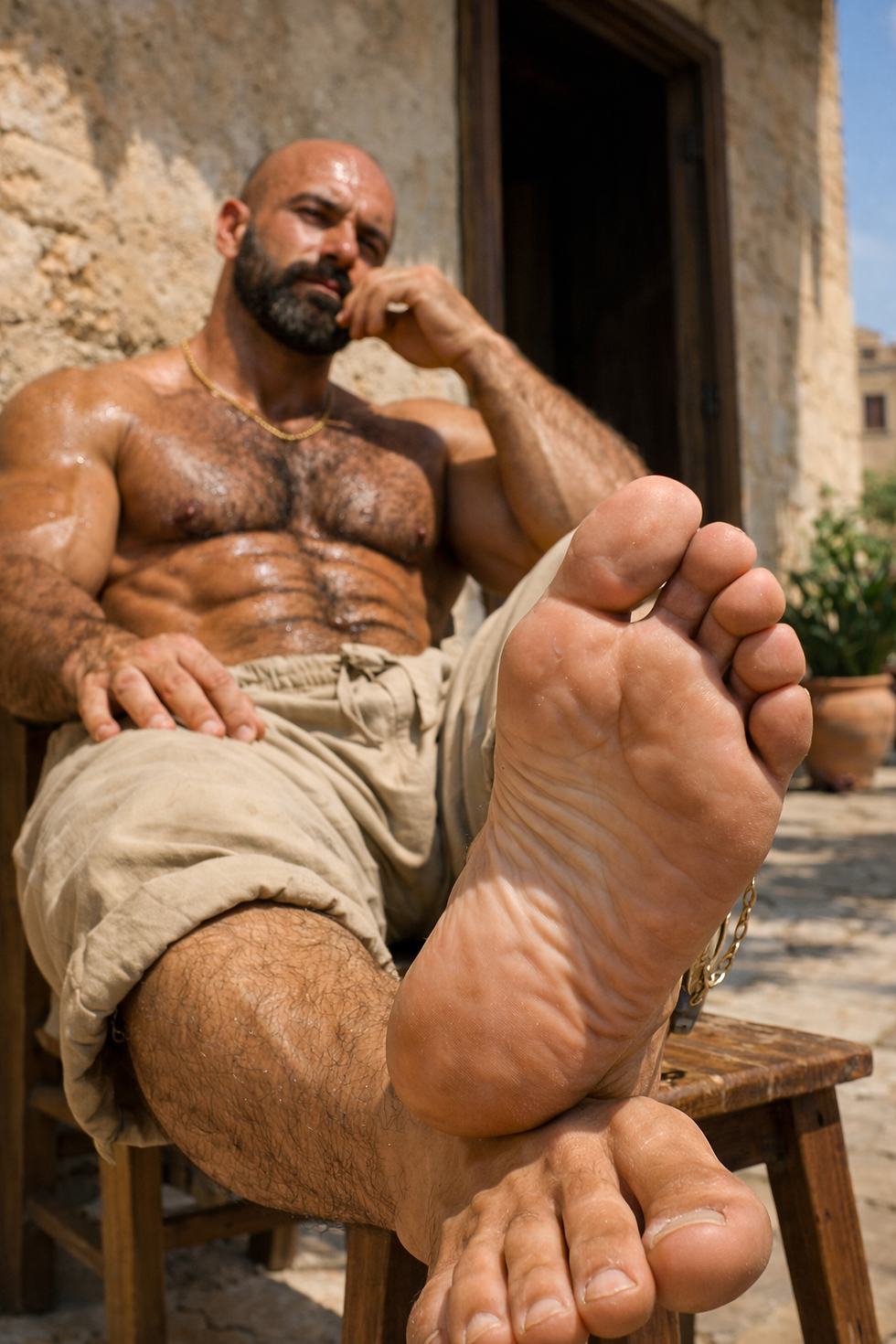
How does one write to someone who is more than a man?
A temptation of flesh. A light that does not pale in daylight. The morning star.
I remembered something I had read in a book in New York.
“Morning star” — a name that can carry both: Lucifer and Jesus. Temptation and salvation.
And that was exactly how he felt: sin and salvation in the same form. Radiant.
Everything in my soul was already kneeling before him.
No matter who he truly was.
I lowered my gaze to the sheet and the pencil in my hand.

And in that moment — as if writing were not only a movement, but a confession — my fingers forgot for a breath how to form letters. It was ridiculous. I could write. I had learned it in school.
But this… was different.
This was not text.
This felt as if I were selling my soul to him — and not even knowing whether he wanted it at all.
Every word that rose within me did not come upright. It came with lowered head. Like a prayer. Kneeling.
Outside, Giorgio moved again, barely — he stretched his toes as if to feel the sun better, and my body responded before I could think. Soft. Ready. Like an animal that has long recognized its master. I wanted to serve him.
My breath grew shallow.
My hand suddenly weak.
The pencil wavered slightly above the paper, as if it were afraid to make the first stroke.
The window glowed. Not only from the light — as if it glowed from within because it held Giorgio, like an icon one must not touch and yet cannot stop staring at.
From arousal I felt dizzy. I closed my eyes briefly, as if I needed to steady myself, and the glare dissolved, like when after too much sun one finally sees contours again.
And in the darkness beneath my lids something began to stir.

Words.
Not beautiful. Not clever.
Honest.
Words I could tell no one and that nevertheless had to come out.
I opened my eyes again.
The sheet lay there.
Empty.
Waiting.
Like a confession without content.
I drew a deep breath, as if I had to decide whether to live or to die.
Whether I would truly give him the letter, I did not yet know. Perhaps I would burn it before anyone found it. Perhaps I would hide it. Perhaps I would be a coward.
But I had to write it.
Because since Giorgio knew my name, something in me could no longer go back. As if with a single look he had shifted me out of my old life and into a new one in which I could no longer pretend I had no hunger.
Outside he sat like a god.

And inside I sat like someone who can no longer flee.
My hand lifted again.
And I knew: I would pour my heart onto this paper.
For him.


